
‘Good, better, best’ is a tried and true product strategy – one that provides consumers with three choices, and often nudges them towards the middle, or so-called ‘Goldilocks zone’. Apple have long been a master of this strategy, often offering either product lines or product configurations in ‘good, better, best’ options. One famous example of this is the October 1999 revision of the iMac G3, where Steve Jobs announced that the line would be splitting into three: the iMac (slot-loading), iMac DV, and iMac DV Special Edition. This provided the blueprint for how Apple would sell Macs right up until very recently, where the online store stopped presenting ‘good, better, best’ configurations by default.
As product lineups expanded, this also became a template for how whole product lines would be positioned – a lower-end, no-frills option that often recycled older components (iPhone SE, the modern no-adjective iPad, Apple Watch SE, etc.), a mid-range model that was often the best option for most use cases (the standard iPhone, iPad Air, Apple Watch Series, etc.) and a high-end, expensive option that pushes technological boundaries (MacBook Pro, iPad Pro, etc.).
However, in recent years, there has often been a fourth model line which doesn’t quite fit into this structure. The iPhone Air has a bigger screen and a better processor than the standard model in a radically different design, but fewer camera features and a worse speaker. The iPad mini is more powerful than the base iPad, but offers a very different iPad experience. These products aren’t strictly better than the other models, nor worse. Just… different.
I was listening to the wonderful Upgrade podcast this week (Episode 606: Photogenic Lemon) where Jason & Myke were reflecting on the new ‘good’ option for Mac laptops: the MacBook Neo. Myke argued that there were too many Apple laptop models already, and that this should preclude the existence of an ultraportable sub-13” model that would be the spiritual successor to the 12” PowerBook G4, 11.6” MacBook Air and 12” retina MacBook.
I’m not sure this is quite right, and it comes down to whether you see the ‘Mac’ as a homogenous family, or two distinct ones: laptops and desktops. It has always struck me as odd that Apple sold many more laptops than desktops, but until last week, only two distinct laptop product lines (Air and Pro) compared to the four desktop lines (iMac, mini, Studio and Pro). But if you look at Apple’s ‘good, better, best… other’ structure that now applies across most of their products, I think it makes perfect sense to complete the lineup with the ‘other’ Mac laptop.
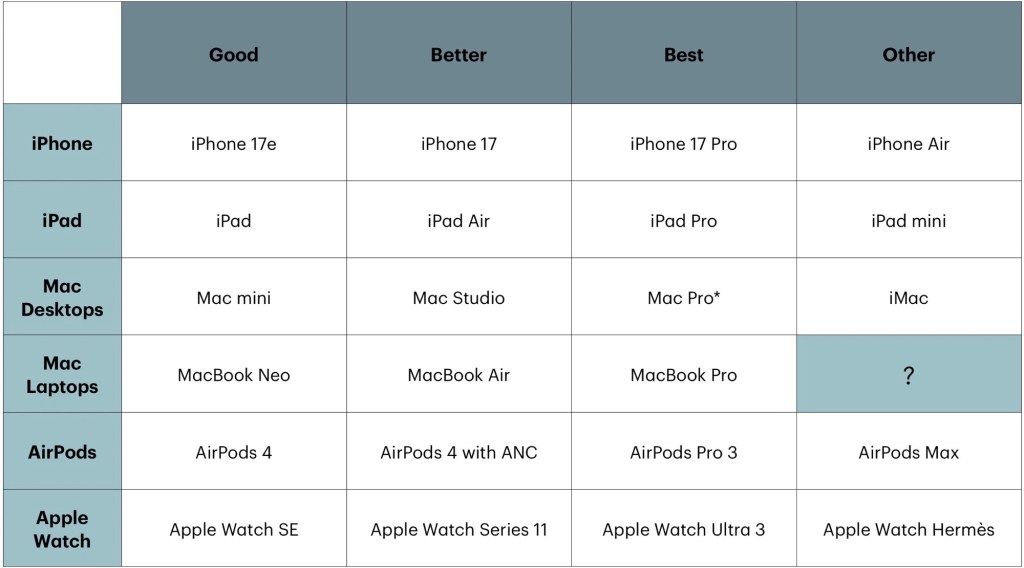
*Yes, ‘best’ is a little subjective here… there is room for a high-end desktop Mac, but the current M2-based Mac Pro certainly is not the ‘best’ desktop Mac, and I wouldn’t be surprised to see it discontinued by the end of this year.
Let’s take a closer look at what sets the ‘other’ products apart from the classic ‘good, better, best’ structure:
- iPhone Air: a radically thin, more design-oriented iPhone. It mixes some cutting-edge technology with some compromises to make a product that is not strictly better than any of the other models, but provides a different experience.
- iPad mini: a more portable iPad, designed more for readers or people who need iPad apps in a much smaller form factor. Like the iPhone Air, it mixes impressive hardware with deliberate trade-offs around the chip and multitasking capabilities.
- iMac: there is an argument to be made that this is actually the ‘good’ option of Apple’s desktop lineup, but it definitely stands out from the other desktops due to its all-in-one design. Again, the iMac more pushes design boundaries than competes with raw tech specs.
- AirPods Max: these over-ear headphones are unlike any other AirPods model, and are probably the best sounding of them all, but they also are not the most technologically advanced: they lack the H2 chip and modern features such as Adaptive Audio and Live Translation.
- Apple Watch Hermès: the ‘other’ Apple Watch again trades more on its looks than any inherent technical advantage: the Hermès models feature more premium bands and exclusive watch faces. They are positioned right at the top of the Apple Watch product range, and top out at a whopping £1,799 – equivalent of 8 Apple Watch SE 3s, plus change.
In each case, the product isn’t simply a step up or down the ladder. Instead, it’s designed around a different idea of what the product should be. They are unlikely to be the best sellers – but they are going to have a key selling point that transcends the ‘good, better, best’ model.
This is exactly where the MacBook even-more-Air should sit: an option that combines some cutting-edge technology (e.g. an up-to-date M chip) with some compromises (screen size and likely battery life) packaged in a way that emphasises its design and its portability. This could be the product that the 12” MacBook gave us a glimpse of over a decade ago, without the crippling compromises. Not better than the Neo, Air or Pro, but not worse either. Just different.
I love my 13” M4 MacBook Air – it’s blazing fast (often faster than my M2 Max Mac Studio!), has great battery life, and a lovely screen. It’s good. But I don’t necessarily want ‘good’ – I’d like a different machine built around compelling principles of ultraportability and cutting-edge design. I’d like ‘other’.
 Moof!
Moof! 
Leave a comment