
This week saw a flurry of new Macs announced by Apple, bumping the iMac, Mac mini, and MacBook Pro to the latest M4 chips. This was expected: the iPad Pro had received this chip 6 months earlier, and Apple seems to be settling into a 12-month upgrade cycle for at least their professional-grade laptops.
What the rumour mill hadn’t predicted, however, was that the Macs with screens integrated – i.e. the iMac and MacBook Pro – would also gain a nano-texture display option. This marks the first time since the non-Retina 2012 MacBook Pro that an Apple laptop can be specced with a non-glossy display, and the first time ever that there’s been an option for different display finishes on an iMac.
This continues the trend of bringing the non-glare option – once reserved only for the exceptionally expensive Pro Display XDR – further down Apple’s lineup. More of these kind of options are great to see. The nano-texture finish is not right for everyone: there are some obvious downsides, like less contrast due to the reflections being diffused, but the trade-off is worth it for many people. This got me asking: is this option priced consistently across each device? How much does it cost a customer to remove the constant glare of their office window from their display? And what could this option look like on an iPhone? Here are three key takeaways from looking at the numbers and calculating what the nano-texture tax is per square inch of display across each device that offers it.
Bigger Doesn’t Mean Expensive-er
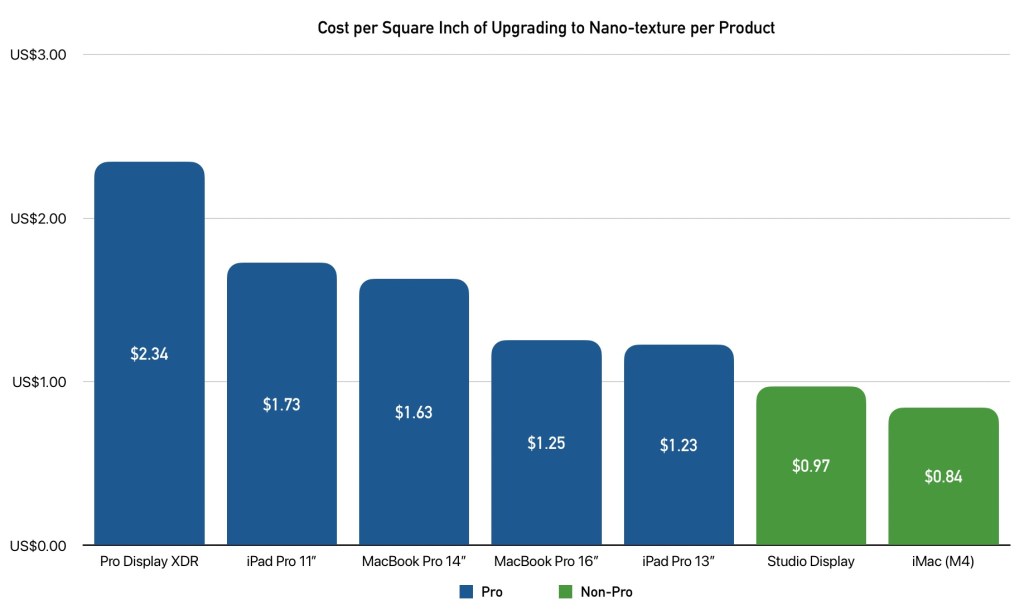
The nano-texture upgrade option has, so far, been the same cost across each respective product line. It’s $100 for an iPad Pro, $150 for a MacBook Pro, no matter the screen size. This means the smaller versions of these devices both pay a slightly higher premium when looking at the upgrade cost per square inch of display. Interestingly, the pricing is fairly consistent: there’s only a $0.02/square inch (1.6%) difference between the cost to upgrade the larger iPad Pro and MacBook Pro, and a $0.10/square inch (6.1%) difference between the smaller versions of the same device.
There’s a Pro Premium
The best value device to upgrade, as measured by cost per square inch? The new M4 iMac. This works out to just a $0.84/square inch premium over its glossy sibling – 2.8x less expensive than the Pro Display XDR, the device that debuted the nano-texture finish. That costs a princely $2.34/square inch. There are only two devices that aren’t marketed as a “Pro” product which has a nano-texture option: this new iMac, and the venerable Studio Display. Interestingly, these are both the best value devices to upgrade to nano-texture. On average, if you’re a “Pro”, you pay 61% more to chemically etch each square inch of glass for reflection-free goodness.
Nano-texture iPhone? $25, Please… Maybe
If we consider the pricing of the nano-texture option for Apple’s portable devices, these come out to an average of $1.68/square inch for the smaller versions, and $1.24/square inch for the larger ones. The smaller iPhone 16 Pro has a display area of around 14.94 square inches. At $1.68/square inch, this would be a $25.08 upgrade. Using the same logic, it would be a $22.18 upgrade for the Pro Max. However, another way of looking at things is calculating the cost of the option as a percentage of the base price. When doing this for the smaller iPad Pro and MacBook Pro, it averages 7.9% (this is taking the “base price” as the cheapest SKU where nano-texture is an option to add – for the iPad Pro, this is the 1TB Wi-Fi model). This would put the hypothetical nano-texture iPhone Pro closer to being a $80 upgrade.
Is it worth $2.34 per square inch of display to make reflections slightly less noticeable? What about $0.84? That’s for you to decide – but Apple’s upgrade pricing clearly isn’t plucked out of thin air. The iPhone and Apple Watch are now the only two product lines with a screen that now don’t offer a less reflective option (Vision Pro notwithstanding…) – and now you know how much to expect to need to dig into your wallet if Apple ever give us the option.
 Moof!
Moof! 
Leave a comment